How Thought Leadership, Integrated Campaigns, and Recognition Help Marketing and Sales Move Government Approvals Forward
In the state and local government market, the difference between winning and losing doesn’t come down to features or price. It comes down to trust.
Public sector leaders face no shortage of vendors pitching “innovation,” but most pitches collapse under scrutiny because they read like sales or marketing collateral, not authoritative guidance. Worse, most vendors show up sporadically, leaving government buyers unfamiliar—or skeptical—about who they really are or their commitment to their mission.
The companies that win are the ones that set the agenda. They publish insights that stand up to compliance reviews, circulate in neutral venues, echo what public officials are already debating in legislative sessions and policy rooms, and remain omnipresent in the marketplace. That consistency calms skeptical buyers and signals reliability.
In 2026, the vendors who master proof—credible thought leadership, integrated campaigns, and market recognition—will separate themselves from the pack.
In the public sector:
- Marketing builds the proof, and sales activates it.
- Marketing creates policy-aligned insights, compliance-aware tools, and visible campaigns that establish credibility. Sales introduces that proof at the right moment—when an executive champion needs support, when security requests documentation, or when finance asks for justification.
When these functions operate together, proof becomes the mechanism that moves deals from interest to internal review to approval.
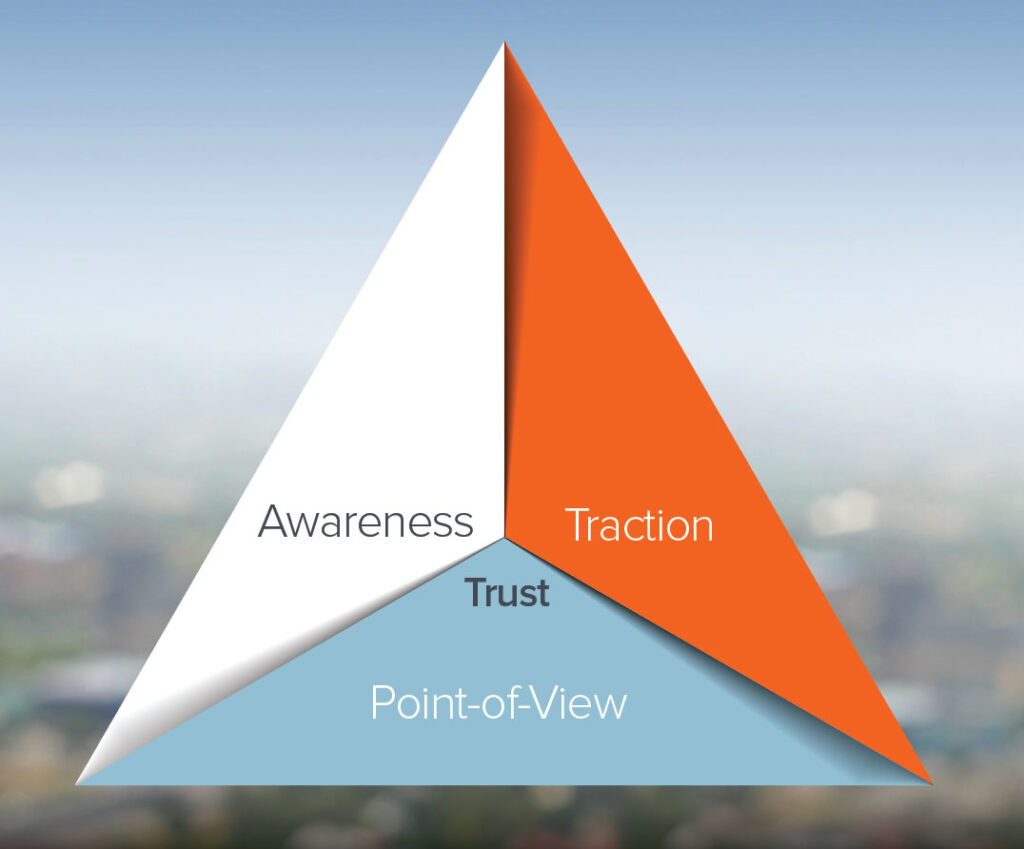
1. Thought Leadership as a Trust Builder
In state and local government, thought leadership isn’t a luxury—it’s the foundation of credibility. The real audience isn’t just one key decision-maker; it’s the IT teams, the budget overseers, legal reviewers, and procurement officers who must all greenlight a deal. They don’t trust promises—they trust unbiased proof.
Three non-negotiables define strong thought leadership:
- Public impact first. Every position paper, checklist, or issue brief must connect directly to outcomes for citizens—faster permitting, safer communities, more efficient services.
- Evidence anchored in public data. Gov tech vendors earn credibility by pointing to audits, funding requirements, and compliance mandates—not glossy marketing stats.
- Neutral, idea-first framing. True thought leadership survives agency communications and security review because it isn’t salesy. Vendors who bury product pitches inside “thought leadership” fail.
Persona insight: Security / IT teams demand clarity on compliance, technical controls, and data protection. Finance leaders care more about cost-avoidance, demonstrated budget savings, and risk mitigation. Department heads want citizen or mission-based outcomes. Influencers and policy leaders want ideas that align with public mandates and visible impact.
For marketing, this means creating assets that withstand scrutiny.
For sales, it means knowing when and how to introduce them.
A policy-aligned brief can be shared with an executive champion. A compliance-focused checklist can be forwarded to security. A cost-avoidance explainer can support a finance review. Thought leadership is most powerful when it’s designed to travel internally. If it cannot be forwarded without explanation, it will not survive the approval process.
Tech vendors who consistently publish these credible insights earn recognition not as vendors, but as interpreters of government priorities—a position competitors cannot easily displace.
2. Integrated Campaigns Build Proof
Proof isn’t built in a single asset—it’s constructed over time, through integrated campaigns.
Disconnected tactics—an occasional webinar here, a checklist there—don’t accumulate enough weight to move cautious state and local government buyers. To succeed, you must maintain sustained visibility, using an always-on (evergreen) approach that builds familiarity and momentum over time.
The campaigns that resonate follow a disciplined rhythm with overlap:
- Point of View (Weeks 1–4): Establish your stance with a bold POV that frames a pressing issue.
- Practical Tools and Content (Weeks 2–6): Provide a checklist, calculator, or benchmark table to turn the POV into actionable guidance.
- Anchor Event (Week 5–8): Gather the audience through a webinar, roundtable, or conference to validate the issue in a public forum.
- Follow-Up Nurture (Weeks 7–12): Stay in front of warmed accounts with replay links, reminder nudges, and policy-aligned “why now” messages.
Integrated campaigns don’t just generate leads. They create layered proof that sales teams can sequence. The webinar becomes validation. The tool becomes justification. The follow-up nurture keeps timing aligned to fiscal calendars and policy milestones. Marketing sustains visibility, and sales converts that visibility into movement.
Government buying decisions rarely hinge on a single meeting. They unfold across departments, reviews, and timelines that marketing alone cannot see, and sales alone cannot influence.
Marketing’s role is to create durable, compliance-aware proof that aligns to public mandates.
Sales’ role is to introduce that proof at the right moment in the approval sequence.
When aligned, campaigns are not isolated bursts of visibility—they become structured support for real conversations happening inside agencies.
That alignment is what turns visibility into velocity.
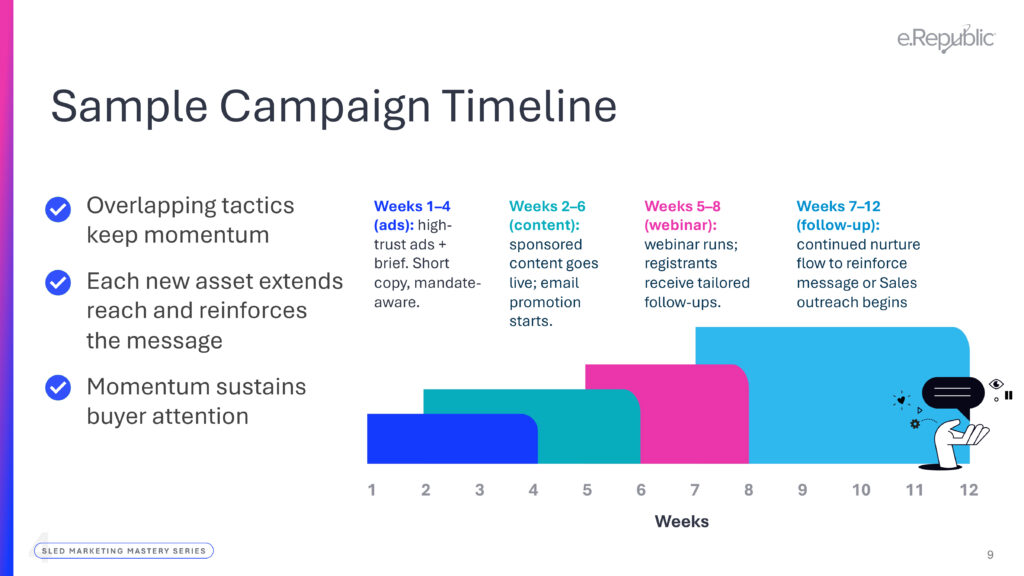
This cadence doesn’t just prove you have insights—it proves you have discipline. Public sector buyers take confidence from consistency, and integrated campaigns signal that your organization isn’t chasing one-off attention but building sustained expertise.
For deeper guidance on the value of integrated campaigns, watch our SLED Marketing Mastery Series Webinar 4: “Disconnected SLED Tactics Waste Time, Integrated Campaigns Make Money.”
3. Becoming Recognized in the Public Sector
In a crowded tech landscape, recognition is the final stage of proof. Without it, even great ideas risk obscurity. Recognition in this space isn’t about splashy logos or generic awards—it’s about being known as a vendor who speaks the language of government and education, and is present when buyers enter the market.
Buyers don’t always announce when they are looking. Mandates, compliance deadlines, and fiscal opportunities trigger buying windows—but research happens continuously. Vendors who are already in the conversation are the ones who get the meeting.
Recognition is earned when:
- Your POVs are cited by decision-makers in procurement and budget discussions.
- Your content is featured in trusted, neutral venues like association briefings or industry publications.
- Your campaigns align with fiscal realities and compliance deadlines.
- Your name consistently appears in conversations—and even internal emails—where public leaders discuss modernization, risk, and citizen outcomes.
Vendors who achieve this recognition aren’t remembered for a single blog or event. They’re remembered because their proof—content, cadence, and credibility—builds a presence that agencies can’t ignore.
To get our quick-hit guide that distills decades of experience into the core principles every vendor needs to win in state and local government, download the “10 Laws of Government Sales & Marketing”.
Recognition reduces friction before a sales conversation even begins. When a vendor’s name is already familiar in trusted environments, sales teams enter discussions as known participants—not unknown risks. That familiarity shortens the credibility-building phase and strengthens internal advocacy.
Benchmarks, Proof Points & Performance Levers
Proof-driven execution is not theoretical—it produces measurable performance gains.
To bring all this into sharper focus, here are benchmarks and proof points drawn from public and industry sources (none tied to direct competitors to e.Republic brands). Most are rooted in broader B2B performance data, but the patterns map closely to the public sector: longer cycles, more reviewers, and larger and more critical audiences—yet the same reality holds that disciplined, well-targeted campaigns dramatically outperform sporadic outreach.
- Lead Conversion Rates: Benchmark data indicates that B2B lead conversion rates generally fall between 2-5% for average campaigns, with well-nurtured or highly targeted campaigns achieving multiples higher. Thunderbit+1
- Typical Website Lead Conversion (all industries): The average website conversion rate runs about 2-3%, while top performing lead generation or landing page experiences can reach 6-7% or more. Thunderbit
- Procurement Analytics Priority Growth: The National Association of State Procurement Officers (NASPO) ranked procurement data and analytics as #2 priority in 2023, up significantly from prior years—highlighting urgency among state procurement leaders to adopt evidence-driven decision-making. KPMG
- AI / Public Sector Use of Emerging Tech: At least 30 states have issued legislation or guidance on state agency use of AI, including procurement changes, oversight, and impact assessment. This shows how compliance, oversight, and policy are becoming non-negotiable in product and campaign narratives. NCSL
- Sales Cycle & Multi-approver Delay: Public sector sales cycles often include steps such as legal, security, procurement review that add 30+ days of delay when compliance artifacts (data flow diagrams, VPATs, alignment to policy) aren’t prepared in advance. (This is a commonly cited pain point in multiple SLED-focused posts and research summaries). Lead411+1
For vendors, the takeaway is clear: even if your absolute volumes are smaller than in commercial markets, integrated, well-timed campaigns can still double or triple engagement and conversion—especially when aligned to fiscal calendars and policy milestones.
Closing: Proof Is the Strategy
2026 is not the year to blend into the noise. Vendors who still rely on scattered campaigns or logo walls as proof will continue to stall in security, legal, or procurement review.
The market winners will be those who:
- Establish thought leadership as trust currency,
- Integrate campaigns into sustained proof, and
- Achieve recognition as true interpreters of their mission.
Vendors who understand this shift are investing in environments where public-sector research already occurs—neutral editorial platforms, policy-aligned content ecosystems, and integrated campaign frameworks built for government buying cycles.
Showing up consistently in those environments ensures your message is not an interruption—but part of the broader conversation shaping modernization, risk management, and citizen outcomes.
Platforms like GovTech, Governing, the Center for Digital Education, and Emergency Management sit at the intersection of insight, audience access, and execution—where proof is built and deployed at scale.
To explore more insights, research, events, and strategy guidance for navigating the SLED procurement maze, connect with your e.Republic representative or email marketing@erepublic.com.