Discover how gov tech and ed tech vendors can win in 2026 by mastering procurement, aligning with SLED decision-makers, and executing integrated campaign s.
Why 2026 Is Not Just Another Year
2026 is not a continuation of the status quo—it is an inflection point. The next 12–18 months will separate vendors who know how to win in state, local, and education (SLED) from those who fade into procurement purgatory.
The facts are undeniable: procurement cycles are lengthening, budgets are tightening, and SLED leaders are absorbing new federal mandates that add compliance, reporting, and adoption requirements. Each new funding stream or mandate pushes more responsibility onto state and local government, and educational administrative teams that are already stretched thin. At the same time, citizen and student expectations for fast, digital-first service delivery are escalating, often faster than governments and educational institutions can realistically adapt.
In this environment, gov tech, ed tech, and consultancy firms face a stark choice. This year demands more than awareness—it requires precision messaging and sequencing that mirror how SLED leaders actually approve purchases. Position your sales team as indispensable partners who understand their challenges and can enable mission delivery.
Procurement Is the Frontline
Procurement is not a hurdle to navigate—it is THE playing field where gov tech and ed tech opportunities are won and lost. RFPs and long evaluation processes are not designed to slow modernization. They exist to enforce rules, ensure transparency, and withstand scrutiny from auditors, legislators, and taxpayers.
For SLED leaders, risk reduction is paramount. That’s why procurement cycles hinge on three factors:
- Peer validation – A majority of SLED buyers cite peer-case studies and third-party validation as critical purchase drivers. If peers in similar states, districts, or agencies have validated a solution, it becomes safer to buy.
- Benchmark alignment – Nearly every state and educational institution now ties digital transformation funding to measurable benchmarks in federal programs such as the Infrastructure Investment and Jobs Act (IIJA) or cybersecurity frameworks. If a vendor’s value proposition mirrors the metrics policymakers already trust, the path to “yes” shortens dramatically.
- Risk mitigation – Every deal must stand up to compliance audits and public accountability. The solution isn’t just being judged on merit; it must survive political, fiscal, and operational scrutiny.
Because of this, glossy marketing won’t cut it. Sales and marketing teams must equip their organizations with ROI models, compliance-ready language, procurement-aligned narratives, and credible evidence.
This is where e.Republic’s broad ecosystem helps vendors speak the language of the public sector. Through the Center for Digital Government, the Center for Digital Education, and the Center for Public Sector AI’s research and programs, Industry Navigator’s procurement intelligence, Government Technology’s coverage of the state and local IT market, and Governing’s policy analysis, and Emergency Management’s coverage on crisis response, the public sector’s priorities and constraints are continuously monitored, benchmarked, and contextualized. These insights help technology vendors servicing the government and educational institutions anchor their storytelling—and their solutions—in the real-world environment SLED buyers operate in.
It was said earlier but bears repeating—in 2026, the sales and marketing teams who mirror the rigor of procurement in their campaigns—and who leverage trusted, public-sector-specific intelligence—will become their organization’s competitive advantage.
The Network of Influencers Is Bigger Than You Think
Too many marketing teams still build campaigns around their internal org chart—reflecting how sales or product teams are structured—instead of mapping to how government and educational institutions actually buy. Every major decision requires consensus across fiscal, technical, and operational domains.
The consistent decision-making nucleus includes:
- Executives, Champions, and Program Roles (including elected and appointed officials) – They set direction, define success, and determine whether an initiative moves forward. This group owns the mission problem, prioritizes initiatives, and shapes internal perception. If they don’t see alignment to outcomes, policy, or public value, the effort never gains traction or funding.
- Finance / Budget Roles – They control funding and demand defensible cost justification. A compelling solution without a clear funding path, audit trail, or long-term value case will not advance.
- IT, Security, and Technical Roles – They validate feasibility, integration, security, and risk. No solution is implemented without their approval.
- Legal Roles – They assess contractual risk, regulatory alignment, data privacy, and statutory obligations. Late-stage legal concerns are one of the most common causes of stalled or reset deals.
- Procurement Roles – They ensure process integrity and defensibility. Their focus is not innovation—it’s whether the acquisition can withstand scrutiny, protest, and audit.
This is the reality: without Finance and Procurement, your deal doesn’t clear the gate. Without IT and Security, it doesn’t get implemented. Without Legal, it doesn’t survive review. Without an Executive, Champion, or Program Lead, it never gets prioritized, socialized, or funded. Ignore any one of them, and the deal stalls. Ignore any one of them, and you stall.
These are also the groups e.Republic engages every day—through topic-based newsletters, print and online publications, surveys and research, in-person events, and topic-focused networking groups. Hundreds of thousands of state, local, and education leaders rely on our trusted platforms and resources to help navigate this complex market and best serve constituents. As a vendor, you don’t need to guess what these personas care about; their priorities are already revealed through real engagement—across content, events, research, and peer networks within this ecosystem.
The vendors who thrive in 2026 are those who build messaging and proof points explicitly for specific decision makers—and who position their campaigns within channels these audiences already trust.
(For deeper guidance on Personas and Buyer Journey Mapping, watch our SLED Marketing Mastery Series webinar 1: “Your SLED Campaign Isn’t Failing—Your Audience Strategy Is!”)
Integrated Campaigns Get Your Message Front and Center
Understanding procurement and personas is not enough. Too many campaigns fail because execution is fragmented.
The 12-week integrated playbook has become the new baseline to deliver an always-on, evergreen presence—so that no matter when someone enters a buying cycle, your brand and solutions are front and center, aligned to their current needs and where they’re at in the buying journey.
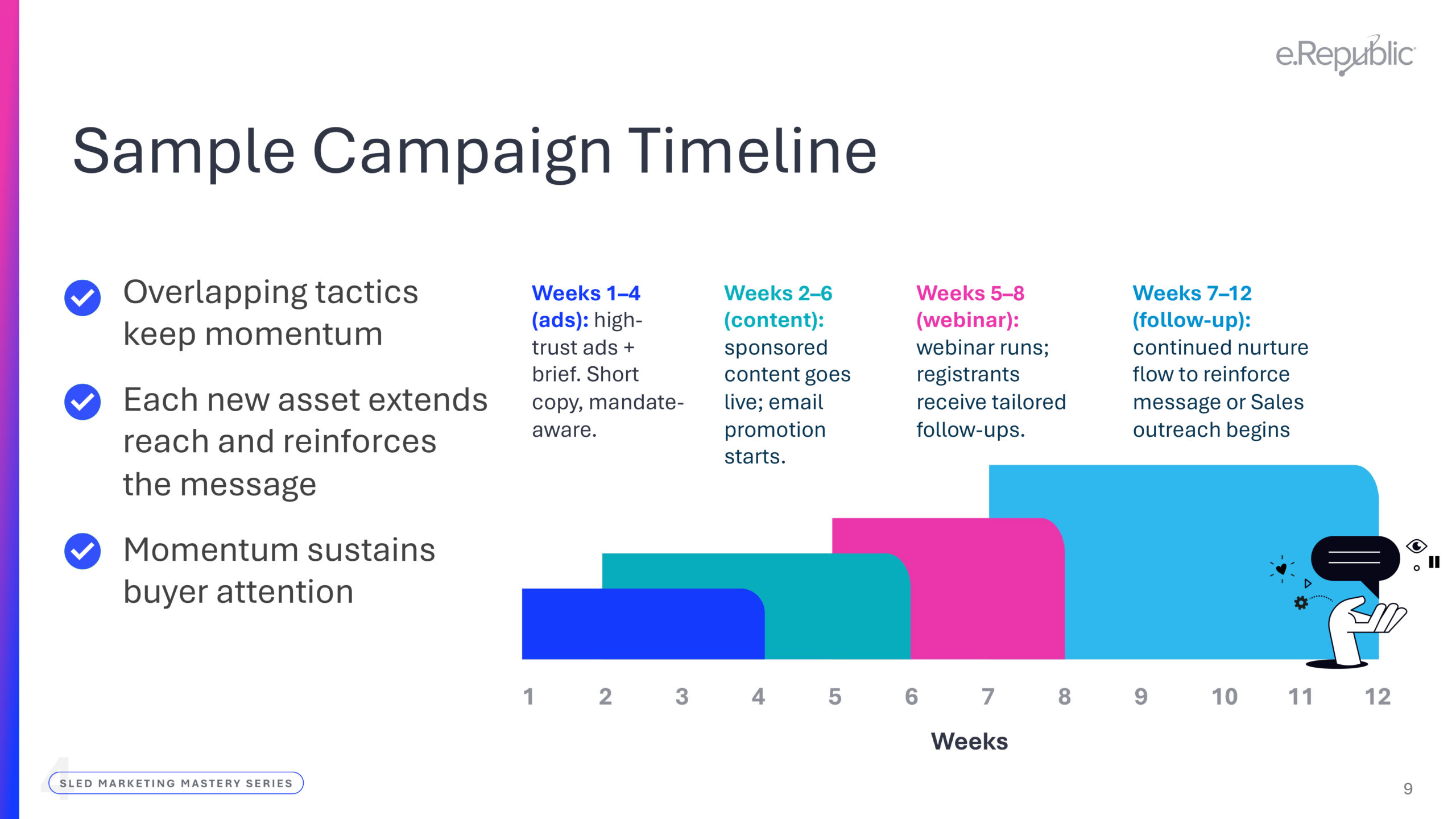
Image from the ‘Disconnected SLED Tactics Waste Time, Integrated Campaigns Make Money’ webinar, slide 9—part of the SLED Marketing Mastery Series.
When executed with discipline, the results are consistent: integrated efforts launched across a 4+ channels outperform single- or dual-channel campaigns by 300%. These are non-negotiables. In 2026, they are survival metrics. (Citation: https://www.klaviyo.com/blog/integrated-marketing-campaign)
(Watch SLED Marketing Mastery Series webinar 4: “Disconnected SLED Tactics Waste Time, Integrated Campaigns Make Money” for the full breakdown.)
Defining the Standard for 2026
Vendors who do these three things without compromise in 2026 will win:
- Ground their campaigns in procurement reality.
- Align messaging to reach the full sphere of influencers.
- Repeatedly execute campaigns with integrated discipline across 12-week rotations.
Those who fall short or fail will likely keep burning resources on disconnected campaigns and stalled marketing programs.
SLED buyers are not looking for flashy technology. They are looking for partners who solve mission problems, simplify procurement, and prove value through peers. For marketing leaders, the path forward is clear: build campaigns that are synchronized, persona-informed, and procurement-aware, and make sure marketing isn’t just driving SQLs—but staying involved through pipeline progress to influence revenue outcomes.
This is how e.Republic brings buyer priorities and vendor strategies together.
Across GovTech, Governing, the Center for Digital Government, the Center for Digital Education, the Center for Public Sector AI, and Emergency Management, our platforms reach and convene the leaders responsible for shaping state and local priorities. With hundreds of thousands of public officials from more than 28,000 agencies nationwide, e.Republic is the trusted environment where public-sector leaders and the private sector come together.
“2026 will not wait. The vendors who shift from disconnected, product-first tactics to buyer committee-aligned, integrated campaigns will own the future of gov tech and ed tech. The rest will struggle or be left behind.”
Scott Hogg, Vice President of Marketing at e.Republic
To explore more insights, research, events, and strategy guidance for navigating the SLED procurement maze, connect with your e.Republic representative or email marketing@erepublic.com.